The Maguire Farm

Custom Search

Home

Barns

Basement

Bob

Bugs

Cats

Chickens

Cows

Dogs

Ducks

Ferrets

Finch

Fireplace

Fish

Found on the Farm

Goats

Guinea Fowl

Guinea Pig

Herd

Hogs

Horses

House

John Deere

Live Cameras

Lizard

Llamas

Natural Nutrition

Oak Tree

Parakeet

Peafowl

Pigs

Pond

Ponies

Photos

Rabbits

Salamanders

Sheep

Snake

Springhouse

Turkeys

Upper Barn

Videos

Updates

Privacy Policy

Horses with Amie
Horses with Amie

Love Puppies?
Love Puppies?

Guinea Pigs

Type
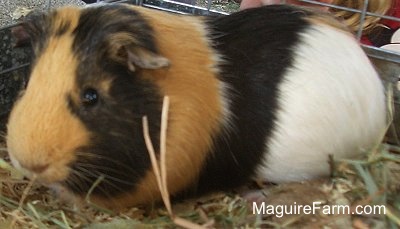
Guinea pigs are in the rodent family (related to chinchillas and porcupines).  Half of the mammals in the world are rodents. The order is so huge that it had to be divided into Suborders: Sciuromorpha - squirrel-like rodents, Myomorpha - mouse-like rodents and Caviomorpha - cavy-like rodents. Guinea pigs are cavy type rodents. They are warm blooded mammals. Like most cavies, the guinea pig has short legs, a short neck, a big head and no tail.

Temperament
Entertaining and gentle, the pet guinea pig is vocal and delightful. They have become very popular pets because of their docile temperaments, tendency not to bite or scratch when handled, relatively clean habits and availability. They are sociable animals and enjoy daily interaction. When their person walks into the room they let out a "bweeep - uueeeep". as if to say "Hello, got any tasty treats for me today?" A guinea pig tends to run when you try to pick them up, however a guinea pig who has been handled since it was weaned will be well-mannered and gentle once you catch them. Guinea pigs like to live in small, extended family groups, the male guinea defends a small territory. Two males housed together may get into aggressive fights. Guinea pigs who live alone should be placed in a room where they can watch their people and where you can talk to them.

Size
Length: About 10-12 inches (25-30 cm.)
Height: About 5 inches (13 cm.)
Weight: About 2 pounds (.9 kg.)

Housing
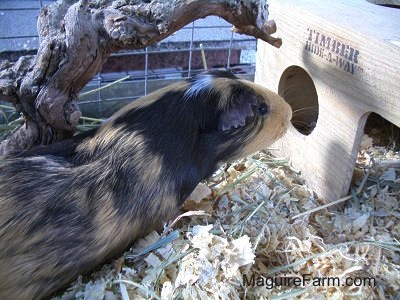
Guinea pigs can be housed within enclosures made of wire, stainless steel, durable plastic, or glass. Keep in mind the following with each; if using a cage with open wire sides, you should look for a cage with a solid bottom with sides that come up at least three inches as the pig will knock pieces of bedding out of the cage. (See photo below.) If plastic or glass aquarium cages are used, be sure to keep the cage extra clean from urine build up as these cages are less ventilated and breathing in the fumes from the urine is very bad for the pig. Wire enclosures are prone to corrosion. Wood and similar materials should not be used in  in the construction of their cage because they are difficult to clean and cannot withstand gnawing. Wood hide-away-huts are ok, however as long as you know they will gnaw on them. These huts should be thrown away every month and replaced wit a new one should urine start to build up along the edges. Guinea housing should have 100 square inches of floor area per adult. An open topped enclosure can be used as long as the sides are at least 10 inches high. Solid floor enclosures with easy to clean dust free beddings are best for guinea pigs. Your guinea pigs home should be easy to clean, well lighted, and ventilated. Shredded paper, wood chips, and processed corn cob are preferred bedding materials. Sawdust should be avoided because it tends to collect within the external genitalia of males, forming an impaction. Avoid cedar shavings as the pleasant smelling odor they put off can actually be toxic to the animal.

Clean-up
Cages should be cleaned out at least every other day even if you use the wire mesh drop through bottom. A wire mesh drop through bottom is not always recommended, as the bottoms of the pigs feed can become injured and so can their legs, should their claws get stuck in the mesh. Urine must be cleaned from the bottom of the cage ever week using a disinfectant for animals and vinegar to scrub away crystalline deposits of urine.

Grooming
Nails should be clipped on a regular basis. Toe nails that are not clipped will start to curl back around and grow into the pigs foot. Short and medium haired guinea pigs require less grooming, but some very long haired guinea pigs need their coats brushed so they do not get tangled. The coat of the long-hair may be very long, draping all around, covering the feet and trailing behind it as much as 6 inches. This type of coat requires regular, careful grooming. Longhaired guinea pigs are often the types shown in guinea pig shows. Show pigs with hair long enough to sweep the floor are kept in rollers to reduce tangling and matting with dirt or feces. Long haired guinea pigs are not found in the wild but is a mutation that was bred into captive guinea pigs. The hair on longhaired guinea pigs never stops growing much in the same way has humans and horse tails. Most other mammal hair reaches a certain length and then stops until the root either falls out or is pulled from the follicle. Guinea pigs do not require regular baths but may need one if they are extremely dirty or have had diarrhea. Show guinea pigs are usually not bathed at all if it can be helped because bathing removes the oils in the coat. Guinea pigs like to groom themselves and those around them. If a guinea pig is sitting on your lap they may start to groom the human. Stroking the pig or one-finger scratching behind the ear will often elicit grooming. Be careful when a guinea pig starts to groom your skin as even a scrape from their sharp rodent teeth can result in a pinch that can hurt.

Feeding
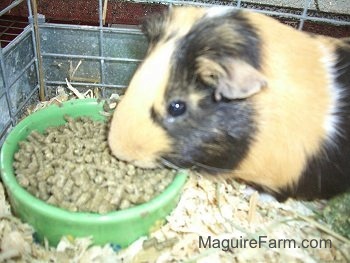
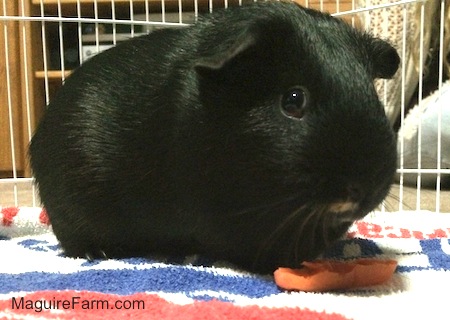
All cavies are herbivores (vegetarians) They eat a variety of fruits and vegetables along with alfalfa pellets with vitamin C, plus green grasses. A rich alfalfa or timothy hay is a great food for a guinea pig and should be fed daily. It not only is great for them but gnawing on the hay keeps their teeth filed down. Alfalfa and timothy hay can be found in most pet stores. Like humans, guinea pigs do not make their own vitamin C, so they must always eat foods high in vitamin C and should have some kind of vitamin supplement which you can pick up at just about any pet store. Note that rabbit pellets and guinea pig pellets are different. Guinea pig pellets have added vitamin C in them where as rabbit pellets do not, however keep in mind, pellets older than 6 weeks loose over half of their added vitamin C. Guinea pigs take in small amounts of food all day long. You can feed your guinea pig pellets and fresh fruit and veggies twice a day and leave alfalfa or timothy hay for him to munch on when you are away. Keep watch that your pig is not putting on too much weight. Any fresh food fed should be thoroughly washed before feeding. Water should be available and fed in a gravity driven hanging bottle at all times. These bottles can be found in your local pet store. Guinea Pigs like to gnaw on things. They have front teeth that never stop growing so it is important to provide things for the guinea pig to gnaw on to keep these teeth filed down. If the teeth grow too long they will not be able to eat. If your guinea pigs teeth appear to be getting too long take it to the vet, the vet can file the teeth down to normal size.


Exercise
Guinea pigs will enjoy being taken out of their cage for some freedom. Since they are bigger and slower than hamsters they are easier to monitor. A guinea proof enclosure should be set up. Be sure there is nothing you do not wish for them to chew in reach such as wires or potted plants and that there are no other pets around that can harm them. Do not put your guinea pig in an exersise ball because guinea pigs are very temperature sensitive and will quickly over heat inside the ball.

Life Expectancy
About 4-8 years, some have been known to live up to 10 years

Health Problems
Prone to intestinal infections, heat stress/heat stroke, foot conditions, pneumonia, malocclusion of premolar teeth cancer and scurvy/vitamin C deficiency. A vitamin C deficiency is common among domestic guinea pigs. Too little vitamin C can kill a guinea pig and too much can also do the same. There are vitamin C supplements you can give your pig. Consult your vet about giving him supplements, what type to feed and how much to give. Guineas are also prone to some skin problems such as fungal growth and mites. If your guinea pig appears to be scratching and or loosing its coat, consult your vet. They are also very temperature sensitive and should not be exposed to extreme temperature changes. They can over heat quickly if kept in small areas that do not allow air flow.

Gestation
Guinea pigs are bred in the summer months. Gestation is nine weeks, a long time compared to other rodents. Unlike mice and rabbits, guinea pigs are born with fur and their eyes open. They look like little miniature versions of their parents when they are born. They nurse right away and will even start eating solid food 2 or 3 days after they are born, however they will nurse for 2-3 weeks. They usually have litters of 1-4 young. Sexual maturity is reached at about 60-70 days. They will continue to grow for several more months. Males left with the females in captivity will try to drive young guineas away soon after weaning.

Origin
In America Guinea pigs are called Cavies. Guinea pigs came from South America, where they were domesticated by the Incas in 2000 B.C. and appeared in Europe in the 1500's. The Incas used to farm them for food as a source of protein. In fact even today you can still order a fried Guinea pig in South America. Wild guinea pigs still live in parts of South America, they inhabit grassland and rocky regions from Peru to North Argentina. Wild guinea pigs live in family groups and occupy underground burrows deserted by other animals. They are active at dawn and dusk and feed on grass and leaves. They live in groups of 5-10. A young Guinea pig can run when it is only three hours old! Some species of wild Cavy can be as long as a meter. Some say they are called guinea pigs because they were brought to Europe by Spanish sailors from a country called Dutch Guiana in South America; while others say it was because in England they were sold for a guinea, which is a coin. Guinea pigs are often used for medical research. That's where we get the term "Guinea Pig" to describe somebody who volunteers to go first.

Copyright Dog Breed Info Center® www.dogbreedinfo.com - Used with Permission

Guinea Pig


Guinea Pig


The Material contained herein may not be reproduced without the prior written approval of the author. Contents & Graphics Copyright © Maguire Farm (C) 2001-. All Rights Reserved. Our work is not Public Domain.